
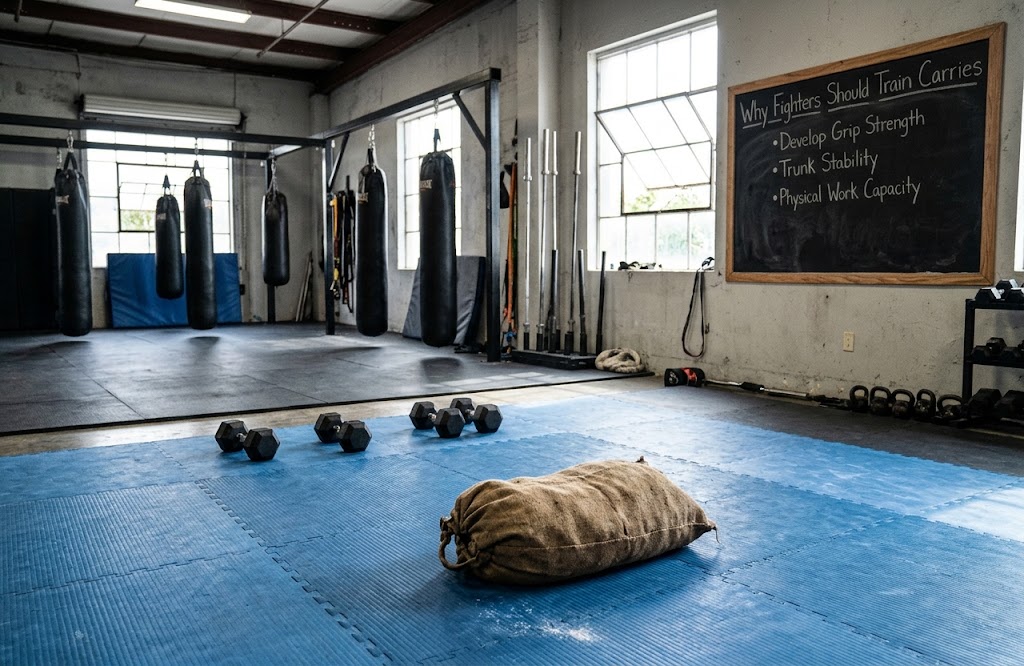
How loaded carries can develop grip, trunk strength and physical work capacity.
Why Fighters Should Train Carries
Fighters spend a great deal of time developing speed, technique, timing and conditioning. They punch, kick, wrestle, grapple, drill and spar. Strength training is also part of many fighters’ programmes, usually built around exercises such as squats, deadlifts, presses and pull-ups.
But there is another simple training method that deserves a place in a fighter’s preparation: loaded carries.
Picking up a weight and carrying it from one place to another may not look as technical as a barbell lift or as exciting as a heavy bag session. Yet carries challenge several physical qualities at once. They demand grip strength, trunk stability, posture, coordination and the ability to keep working while under load.
For fighters, these qualities can be useful—not because carrying a heavy object perfectly imitates a fight, but because it develops a stronger physical foundation for demanding activities.
What Are Loaded Carries?
Loaded carries are exactly what they sound like: you pick up a weight and carry it for a distance or for a set amount of time.
The weight can be a pair of dumbbells, kettlebells, a barbell, a sandbag, a farmer’s walk implement or another suitable object.
There are several common variations:
- Farmer’s carry: A weight is held in each hand at the sides.
- Suitcase carry: One weight is held in one hand, challenging the body to resist leaning.
- Bear-hug carry: A sandbag or other object is held against the chest.
- Front-loaded carry: A weight is held in front of the body.
- Overhead carry: A weight is held overhead while walking.
- Shoulder carry: An awkward object, such as a sandbag, is carried over one shoulder.
Each variation places slightly different demands on the body. The simplest options are often the best place to start, especially for people who are new to loaded carries.
Grip Strength That Lasts
Grip strength is important in many combat sports.
In grappling, athletes use their hands to control wrists, sleeves, collars, limbs and body position. In wrestling, grip and hand control can influence whether an athlete can establish or maintain a hold. Even in striking sports, the hands and forearms are repeatedly involved in gripping, clinching, framing and controlling an opponent.
Carries provide a straightforward way to challenge the grip under sustained tension.
During a farmer’s carry, the hands must hold onto the implements while the body moves. The grip is not being tested for one brief effort; it must continue working throughout the entire carry. As the distance increases, the forearms and hands are required to maintain their effort for longer.
This can help develop grip endurance and the ability to hold onto a load while fatigued.
However, grip strength is specific to the task. Holding dumbbells for a long walk does not automatically make someone better at every type of grappling grip. Carries should complement sport-specific grip training, not replace it.
A Strong Trunk Under Load
A fighter’s trunk does more than produce visible abdominal muscles. It helps transfer force between the upper and lower body, maintain posture and resist unwanted movement.
Carries challenge this role in a practical way.
When walking with weights, the body must remain organised while each step creates movement through the hips and torso. The trunk works to maintain a stable position rather than allowing the load to pull the body out of alignment.
The suitcase carry is especially useful for challenging the body’s ability to resist leaning sideways. A bear-hug carry places a different demand on the trunk, as the athlete must maintain a strong position while holding an awkward load close to the body.
This is relevant to the general physical demands of fighting, where athletes must maintain posture while moving, pushing, pulling, clinching or resisting an opponent’s pressure.
Carries do not perfectly reproduce those situations. An opponent is dynamic, unpredictable and actively resisting. But carries can help build the basic strength and control needed to manage external loads.
Learning to Move While Holding Weight
Many strength exercises take place in a relatively fixed position. Carries introduce movement.
The athlete must walk, breathe, maintain balance and manage the load at the same time. This makes carries a useful way to train coordination under resistance.
A fighter’s physical preparation should include more than producing force in one position. Athletes need to move while maintaining control of their bodies. Carries offer a simple way to practise this.
The load also changes the way the athlete moves. A heavy farmer’s carry requires a different posture and grip from a bear-hug sandbag carry. A suitcase carry challenges balance differently from carrying two evenly distributed weights.
This variety is one reason carries fit well into unconventional strength training. The athlete learns to handle different objects and positions instead of relying on one familiar movement pattern.
Building Work Capacity
Fighting requires repeated efforts. Depending on the sport, an athlete may need to strike, grapple, defend, move and recover over several rounds or matches.
Loaded carries can contribute to general work capacity because they combine muscular effort with sustained movement. A challenging carry raises the demand on the muscles and cardiovascular system, particularly when performed for longer distances or repeated for several sets.
That does not mean carries are a substitute for sport-specific conditioning. Running, intervals, pad work, sparring and grappling rounds each develop different qualities.
Instead, carries can be used as one component of a broader programme. They provide a different type of physical challenge and can help fighters become more comfortable working while holding a load.
The key is to use them in a way that supports the rest of training. If carries leave an athlete’s grip and trunk exhausted before an important technical session, the timing or volume may need to be adjusted.
Why Sandbags Work So Well
Sandbags are particularly useful for carries because they are awkward, soft and often unstable.
Unlike a dumbbell, a sandbag may not have a convenient handle. The athlete has to grip the fabric, squeeze the load or hold it against the body. As the sand shifts, the bag can change shape slightly during the carry.
This makes sandbag carries a practical option for fighters who want to develop strength while handling an unconventional object.
A bear-hug carry is a good example. The athlete lifts the bag, holds it close to the chest and walks while maintaining a strong posture. The arms, upper back and trunk all contribute to keeping the load secure.
A shoulder carry offers another challenge. The bag rests over one shoulder, creating an uneven load that requires the athlete to maintain balance and control.
These exercises can be demanding, so the weight should be selected carefully. The aim is to carry the bag with control—not to stagger through a distance while losing posture.
How Fighters Can Add Carries to Training
Carries are easy to include because they require little equipment and can be performed in a relatively small space.
A fighter might add them after a strength session, include them in a conditioning workout or use them as a short finisher on a day when technical training is lighter.
A simple starting point could be:
Farmer’s Carry
- 3 rounds
- 20–30 metres per round
- Rest 60–90 seconds between rounds
Bear-Hug Sandbag Carry
- 3 rounds
- 20–30 metres per round
- Rest as needed to maintain good technique
Start with a load that allows you to walk steadily, breathe and maintain control. Increase the distance, load or number of rounds gradually rather than trying to progress every variable at once.
For fighters with demanding training schedules, a little can go a long way. Two or three carry variations performed consistently may be more useful than an exhausting carry circuit added on top of everything else.
Don’t Turn Every Carry Into a Test
Carries can be deceptively demanding. It is tempting to keep adding weight until the athlete can barely move, or to turn every session into a competition.
But training should serve the fighter’s overall development.
Choose loads that challenge you while allowing you to maintain a controlled walk and stable posture. Stop a set when your grip begins to fail, your position deteriorates or you can no longer carry the load safely.
Overhead carries require particular care because they place a weight above the body. They should only be used when the athlete has the necessary shoulder mobility, stability and control. They are not essential for every fighter.
And remember: carries are strength and conditioning exercises. They do not teach timing, distance, defensive awareness, striking mechanics or grappling technique. Those skills still need to be practised directly.
Strength You Can Take With You
Loaded carries are simple, but simple does not mean easy.
They challenge the hands, trunk, posture and ability to move under load. They can build general strength and work capacity while introducing fighters to the demands of carrying awkward objects.
For athletes who already spend hours practising technical skills, carries offer a useful way to develop physical qualities that support their sport without requiring complicated equipment or elaborate programming.
Pick up the weight. Stand tall. Walk with control. Put it down safely. Then do it again.
The goal is not to become a champion at carrying sandbags. The goal is to build a body that is better prepared for the physical demands of training and competition.
Fighters should train carries because strength is not only about how much force you can produce—it is also about how well you can hold your position, manage a load and keep moving.
Leave a Reply