
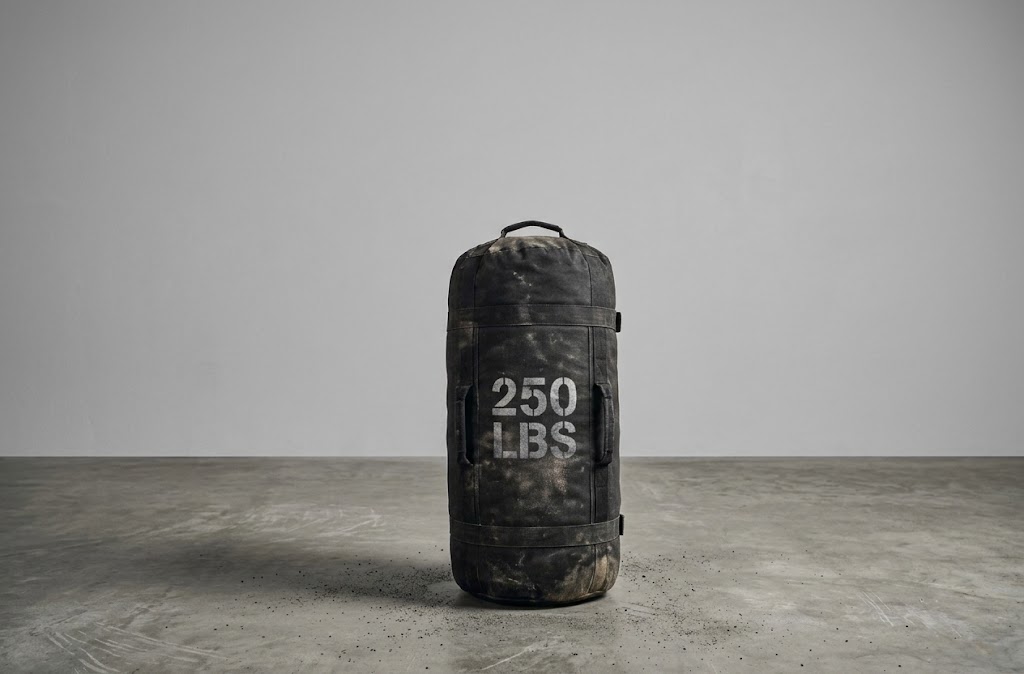
Master the first lift, build real strength, and learn to handle an awkward load.
There is something humbling about a heavy sandbag. You can spend years lifting barbells, dumbbells and kettlebells, building impressive numbers and developing a strong physique. Then you stand in front of a heavy sandbag, reach down to pick it up, and discover that the job is not quite as straightforward as you expected.
The bag has no rigid bar to grip, no evenly distributed plates and no perfectly predictable centre of mass. Its contents shift as you move, its shape changes under pressure, and the harder you squeeze, the more it seems to find a way to escape your grasp.
That is precisely what makes sandbag training so useful.
But before you start shouldering enormous bags or attempting heavy carries, you need to learn the most fundamental movement of all: picking the bag up from the ground.
It sounds simple. Done properly, it is a skill worth developing.
1. Choose the Right Sandbag
Before thinking about technique, choose a bag you can handle safely.
If you are new to sandbag training, resist the temptation to start with the heaviest bag available. A weight that feels manageable for a barbell deadlift may be surprisingly difficult to lift when it is bulky, unstable and difficult to grip.
Start with a load that allows you to practise the movement without losing control of your position. You should be able to lift the bag smoothly, hold it securely and lower it deliberately.
The bag itself matters, too. A purpose-built training sandbag with reinforced seams and a reliable closure is preferable to a makeshift bag that might tear or spill its contents. Check the stitching before training.
One of the biggest benefits of sandbag training comes from learning to handle the bag itself rather than relying exclusively on convenient grips.
2. Get Close to the Bag
Stand facing the sandbag with your feet approximately shoulder-width apart, adjusting your stance to suit the bag’s size and shape.
The first mistake many people make is standing too far away.
When you reach forward for a heavy object, your body must work harder to control the load as it moves away from you. The farther the bag is from your body, the more demanding it can become to maintain a stable position.
Move close enough that you can reach the bag without stretching excessively. From there, bend your knees and hips, lowering yourself towards the load.
Think about bringing your body to the bag rather than reaching down from a standing position with straight legs and a rounded, uncontrolled back.
Your exact position will depend on your proportions, mobility and the dimensions of the sandbag. There is no single perfect stance for every lifter. What matters is finding a position that allows you to grip the bag securely and generate force without losing control.
3. Find a Grip That Works
A sandbag does not offer the same convenient grip as a barbell. You have to build one.
Reach around the sides of the bag and secure your hands against the fabric. Depending on its width, you may be able to grip the material from underneath, pull the sides towards you or clasp your hands around the bag.
The goal is to establish as much control as possible before the bag leaves the ground.
Squeeze firmly. Draw the bag towards your body and avoid allowing your arms to drift away from your torso. You may find that the bag compresses slightly under your grip, helping you secure it.
However, not every bag can be gripped in exactly the same way. A long, narrow bag will feel different from a short, bulky one. Learn to adapt rather than forcing every bag into one particular grip.
This is part of the skill: you are learning how to handle an object, not simply how to lift a predetermined weight.
4. Brace Before You Lift
Before initiating the lift, establish a stable torso.
Take a breath and brace your abdominal muscles as though preparing to resist a firm push to the midsection. Keep your torso controlled and your spine in a comfortable, stable position.
Your back does not have to maintain an artificially exaggerated arch. Instead, aim for a position you can hold under load without collapsing or making sudden adjustments.
Keep your arms engaged, your grip secure and the bag close to your body.
Now pause for a moment.
If your grip is slipping, your position feels unstable or you cannot build up enough tension to control the bag, reset. There is no benefit in rushing into a lift you are not prepared to perform.
The preparation is part of the movement, not wasted time before it.
5. Lift With Your Legs and Hips
Once you are positioned and braced, begin driving through your feet and extending your knees and hips.
Think of standing up with the bag rather than pulling it away from the ground with your arms alone. Your legs and hips provide much of the force needed to raise the load, while your upper body keeps the bag secured.
As the bag rises, draw it towards your body. Avoid letting it swing forwards or drift away from you.
The movement should be controlled, but it does not need to be painfully slow. A smooth, deliberate lift is the goal.
Do not jerk the bag off the ground to overcome a sticking point. If it refuses to move, reassess your grip, positioning and load.
For heavier bags, the initial lift may be the most difficult part of the entire movement. This is perfectly normal. You are overcoming the inertia of an awkward object while trying to maintain a useful position.
Once the bag starts moving, stay connected to it. Keep your arms engaged and your torso stable until you reach the intended finishing position.
6. Bring the Bag Into Your Lap
One of the most useful skills in sandbag training is learning to bring the bag into your lap before completing the lift.
Instead of attempting to raise a bulky bag directly from the ground to your chest in one continuous effort, you can use a controlled intermediate position.
Begin by lifting the bag from the ground and drawing it onto your thighs. Sit your hips back slightly as needed, maintaining control of the load. The bag should rest securely across your thighs rather than hanging awkwardly from your arms.
From this position, you can adjust your grip, bring your arms farther around the bag and prepare for the next stage of the lift.
This is particularly useful when working with larger sandbags. It breaks a demanding movement into manageable parts and gives you an opportunity to reorganise your position before continuing.
The lap position is not a shortcut that makes every heavy bag easy. It is a technique that allows you to manage the load more effectively.
Practise it with a moderate weight before using it with heavier bags.
7. Finish the Lift You Actually Need
Picking up a sandbag can mean several different things. You might simply want to lift it to waist height, hold it in front of your body, carry it across a training area or bring it to your shoulder.
These are different tasks, and each requires its own technique.
For a basic ground-to-waist lift, stand upright with the bag secured against your body. Maintain your brace and avoid leaning backwards to compensate for the load.
For a bear-hug hold, wrap your arms around the bag and squeeze it firmly against your torso. This position can be an excellent starting point for carries.
If your goal is a sandbag-to-shoulder lift, learn that movement separately. It involves additional repositioning and demands more from your grip, torso and coordination. Do not assume that successfully picking up a bag automatically means you are ready to shoulder it.
Likewise, if you intend to carry the bag, establish a secure hold before taking your first step. Start with a short distance and turn carefully rather than twisting suddenly under load.
The best technique depends on what you intend to do with the bag after it leaves the ground.
8. Lower the Bag With the Same Respect
Many lifters concentrate entirely on getting the bag up and forget that lowering it is also part of the exercise.
Do not simply release a heavy bag from waist height because the difficult part is over. Depending on the load and your training environment, an uncontrolled drop can damage equipment, injure someone or create unnecessary strain.
Reverse the movement under control as far as practical. Keep the bag close, bend through your hips and knees, and guide it towards the ground.
If the bag is too heavy to lower safely, it is too heavy for that particular exercise at present.
There may be situations in which dropping a purpose-built bag is appropriate, but the landing area must be clear and the equipment designed to withstand it. Never assume that every sandbag is suitable for repeated heavy drops.
9. Build the Skill Before Adding Weight
The temptation to chase heavier numbers is understandable. Lifting a 200-pound sandbag feels different from lifting a 100-pound bag, and shouldering a truly heavy load is an impressive achievement.
But the foundation remains the same: secure the grip, establish your position, brace, lift with control and keep the bag close.
Practise with a weight that allows you to repeat the movement consistently. Perform a few controlled repetitions, rest, and repeat while your technique remains sound. Gradually increase the weight or difficulty as you become more capable.
You can also train different parts of the movement independently. Ground-to-lap lifts develop familiarity with the initial pull and repositioning. Ground-to-waist lifts allow you to practise standing with the bag. Bear-hug carries teach you to maintain control while moving.
You do not need to test your maximum every session. Consistent practice with manageable loads is a far better way to build a foundation than repeatedly struggling with a weight you cannot handle reliably.
Stop if you experience sharp pain, and seek qualified coaching if you are unsure about your technique.
Final Thoughts
Learning to pick up a sandbag is about more than developing a stronger back or bigger arms. It teaches you to work with an awkward object, establish a grip where none is provided, organise your body under load and adapt when the weight does not behave as expected.
These are skills that develop through practice, not through simply buying a heavier bag.
Start with a manageable load. Get close to it. Find your grip, brace your torso and stand up with control. Learn to use your lap as an intermediate position, and master the basic lift before progressing to carries and shouldering.
The sandbag will challenge you in ways that conventional weights may not. That is part of its value.
You do not need to conquer the heaviest bag in the gym on your first day. You need to learn how to handle the bag in front of you.
Leave a Reply