The strength you build in the gym should mean something outside it.
There is a certain kind of strength that looks impressive on paper. A huge deadlift. A massive squat. A personal record that makes people stop and stare. These achievements take dedication, discipline and hard work, and there is no reason to dismiss them. But there is a question worth asking: how much of that strength carries over into the real world?
Imagine you can deadlift 500 pounds with a barbell. You have trained for years, perfected your technique and built an impressive level of strength. Now imagine having to lift a heavy, awkward object from the ground, carry it across a room, move it around a corner or load it into the back of a vehicle. Suddenly, the task looks very different.
The object shifts. Your grip feels insecure. Its shape makes it difficult to get close to your body. There are no perfectly balanced plates, no knurled steel bar and no convenient position to place your hands.
This is where sandbag training comes into its own.
Strength That Transfers to Everyday Life
Everyday life rarely presents us with perfectly balanced weights. We lift suitcases, carry furniture, move bags of cement, load equipment, transport groceries and help other people move heavy objects. Sometimes we need to pick something up from an awkward position. Sometimes we have to carry it farther than expected. And sometimes the object we need to move is simply difficult to handle.
These tasks demand more than the ability to produce force against a predictable resistance. They require grip strength, coordination, balance, bracing, positioning and the ability to adapt when the load moves unexpectedly.
A barbell is an excellent tool for developing strength. Its rigid shape and balanced design allow us to train progressively and measure our performance precisely. But those same characteristics make it a very different challenge from handling an awkward object.
A sandbag introduces an element of uncertainty. Its contents shift, its shape changes under pressure, and there is rarely a single perfect place to grip it. The load must be controlled throughout the movement, not simply lifted from one position to another.
That is what makes sandbag training so valuable: it challenges us to develop strength that is useful beyond the gym.
The 500-Pound Deadlift vs. the 250-Pound Sandbag
Consider two hypothetical athletes.
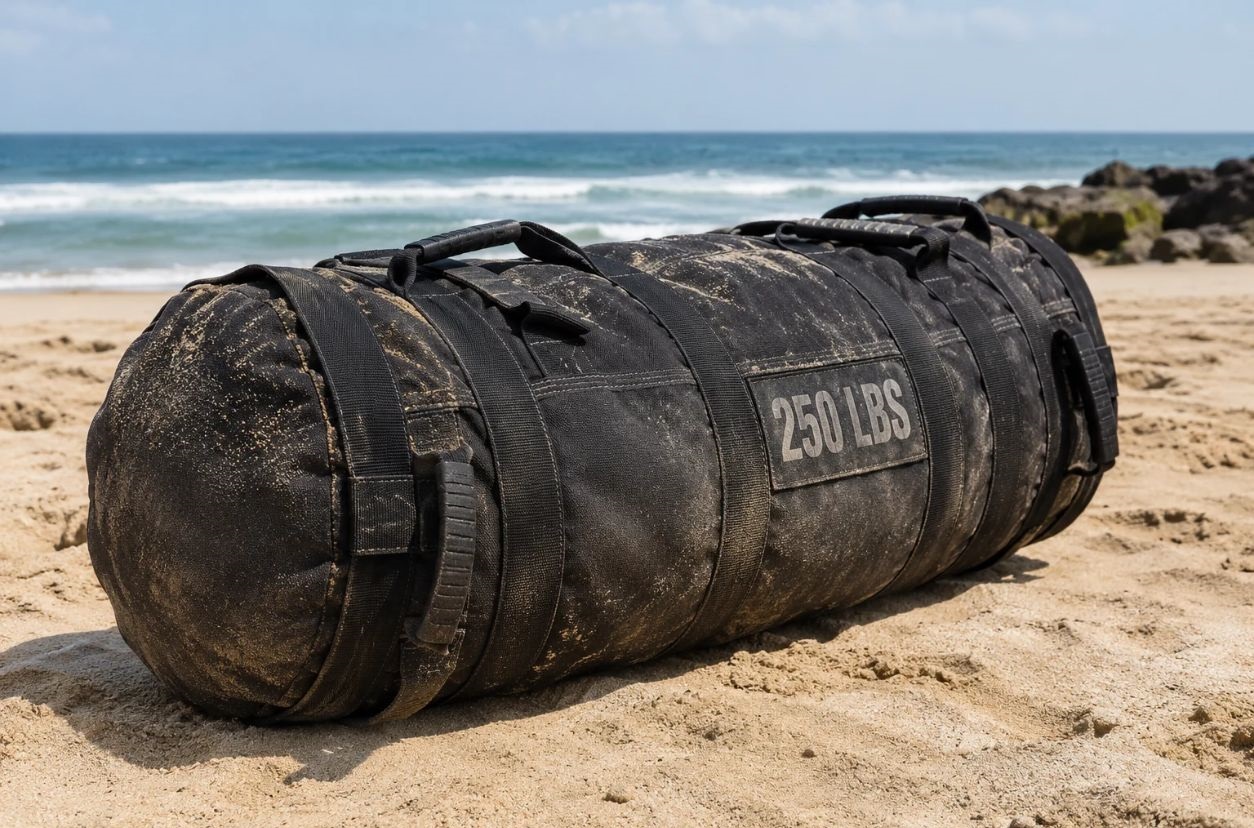
The first can deadlift 500 pounds with a barbell. The second can lift a 250-pound sandbag from the ground and carry it under control.
Who is stronger?
There is no simple answer. The barbell deadlift and the sandbag lift are different tasks, and neither number tells us everything about an athlete’s overall ability. A 500-pound deadlift is an impressive display of strength, while lifting and carrying a 250-pound sandbag is an exceptional feat in its own right.
But ask a different question: which athlete has demonstrated the ability to handle a heavy, unstable object that is difficult to grip and awkward to move?
The second athlete has demonstrated a very specific kind of practical strength.
Someone who can lift a 200- or 250-pound sandbag from the ground and carry it under control has developed substantial strength for handling heavy, awkward loads. Many ordinary lifting and carrying tasks will feel considerably more manageable by comparison.
That does not mean the athlete will automatically be able to lift every object weighing less than 250 pounds. Shape, dimensions, grip, height, distance and the nature of the task all matter. Nor does it mean barbell strength has no practical value. On the contrary, a strong foundation built with conventional weights can be extremely useful.
The point is that strength is specific. Being able to move a barbell does not automatically mean you are equally capable of moving everything else.
Sandbag training helps close that gap.
Embrace the Awkward
One of the defining characteristics of sandbag training is that it refuses to make every movement comfortable.
A sandbag clean requires you to bring an unwieldy object from the ground into a position you can control. A shouldering movement challenges you to lift and rotate the load into position. A bear-hug carry forces you to hold the bag tightly against your body while maintaining your posture and breathing under pressure.
And then there are the carries.
Pick up a heavy sandbag, hold it against your chest and start walking. Within seconds, you will understand that carrying a heavy object is a challenge in its own right. Your trunk must remain braced, your legs must continue working, your grip and upper body must maintain their hold, and your breathing becomes increasingly important as fatigue sets in.
Unlike a single repetition, a carry forces you to sustain control over time and distance.
This is one reason sandbags are so effective for developing work capacity alongside strength. You are not merely producing force for an instant; you are learning to manage a demanding load while continuing to move.
The bag may shift slightly. Your arms may begin to fatigue. Your posture may want to collapse. Your job is to maintain control, recognise your limits and keep moving with good technique.
That is a different experience from lifting a fixed weight through a predetermined range of motion.
More Than Just Muscle
Sandbag training is not simply about becoming stronger. It also teaches you how to organise your body around a difficult task.
Picking up a heavy bag requires you to position yourself effectively, create tension through your torso and use your legs and hips to help generate force. Holding the bag close can be important for maintaining control. Carrying it requires you to coordinate your steps with the demands of the load.
Repeated practice helps you become more familiar with these challenges.
You learn to recognise which positions are manageable and which put you at a disadvantage. You learn that rushing a heavy lift is rarely a good idea. You learn to distinguish between a difficult but controlled effort and a load that is simply too heavy to handle safely.
These lessons are useful well beyond sandbag training.
Of course, no exercise can guarantee that you will handle every real-world situation without difficulty. Different objects demand different techniques, and practical strength also depends on experience, judgement and the circumstances in which a task occurs.
But developing the ability to lift, carry, brace and move under load gives you more tools to work with when physical challenges arise.
A Simple Tool With Endless Possibilities
One of the best things about sandbag training is its simplicity.
You do not need a room full of machines or an impressive collection of specialised equipment. A suitable sandbag, enough space to train safely and a well-planned programme can provide a serious physical challenge.
You can squat with it, press it, row it, clean it, shoulder it, carry it or simply pick it up and put it down repeatedly. You can use lighter bags to develop technique and conditioning or progressively work towards heavier loads as your strength and experience improve.
The possibilities are broad, and the training can be adapted to different ability levels.
A beginner might start with a manageable bag and learn how to lift it from the ground, hold it securely and walk with it under control. An experienced athlete might work towards heavier loads, longer carries or more demanding combinations of movements.
Progress should be earned, not rushed. Sandbags can be deceptively difficult, and poor positioning under a heavy, shifting load can lead to injury. Good technique, sensible progression and appropriate recovery matter just as much as the weight of the bag.
The goal is not to lift the heaviest possible sandbag at any cost. The goal is to become stronger, more capable and better prepared for the physical demands you choose to take on.
Train for More Than Numbers
There is nothing wrong with chasing a personal record. Conventional barbell training has an important place in strength development, and measurable progress can be motivating.
But it is worth expanding your definition of strength.
Can you pick up an awkward object without immediately struggling to find a comfortable grip? Can you carry a heavy load without losing control of your posture? Can you maintain your composure when the weight becomes uncomfortable? Can you continue producing useful effort when a task demands more than a single powerful repetition?
These are worthwhile qualities to develop.
Sandbag training will not replace every other form of exercise, and it does not need to. It complements conventional strength training by introducing challenges that conventional equipment often removes.
The 500-pound deadlift and the 250-pound sandbag carry can both be impressive achievements. They simply demonstrate different abilities.
And if your goal is to build strength that means something outside the gym, those differences matter.
Final Thoughts
Sandbag training brings us back to a straightforward idea: strength should be useful.
Lifting and carrying an awkward load demands more than moving a number from the floor to a standing position. It requires you to grip, brace, coordinate, adapt and maintain control. It challenges your body in ways that can complement conventional training and prepare you for a wider range of physical tasks.
You do not need to abandon the barbell or stop measuring your progress. (But be warned, many lifters who started to train with sandbags infact have abandoned the barbell.) You simply need to recognise that strength has more than one expression.
So pick up a sandbag. Learn to lift it properly. Carry it, move with it and gradually challenge yourself as your ability improves.
Because the real question is not only how much you can lift when everything is perfectly balanced.
It is what you can do when the load is awkward, the grip is difficult and the job still needs to get done.
That is why we train with sandbags.
Leave a Reply