
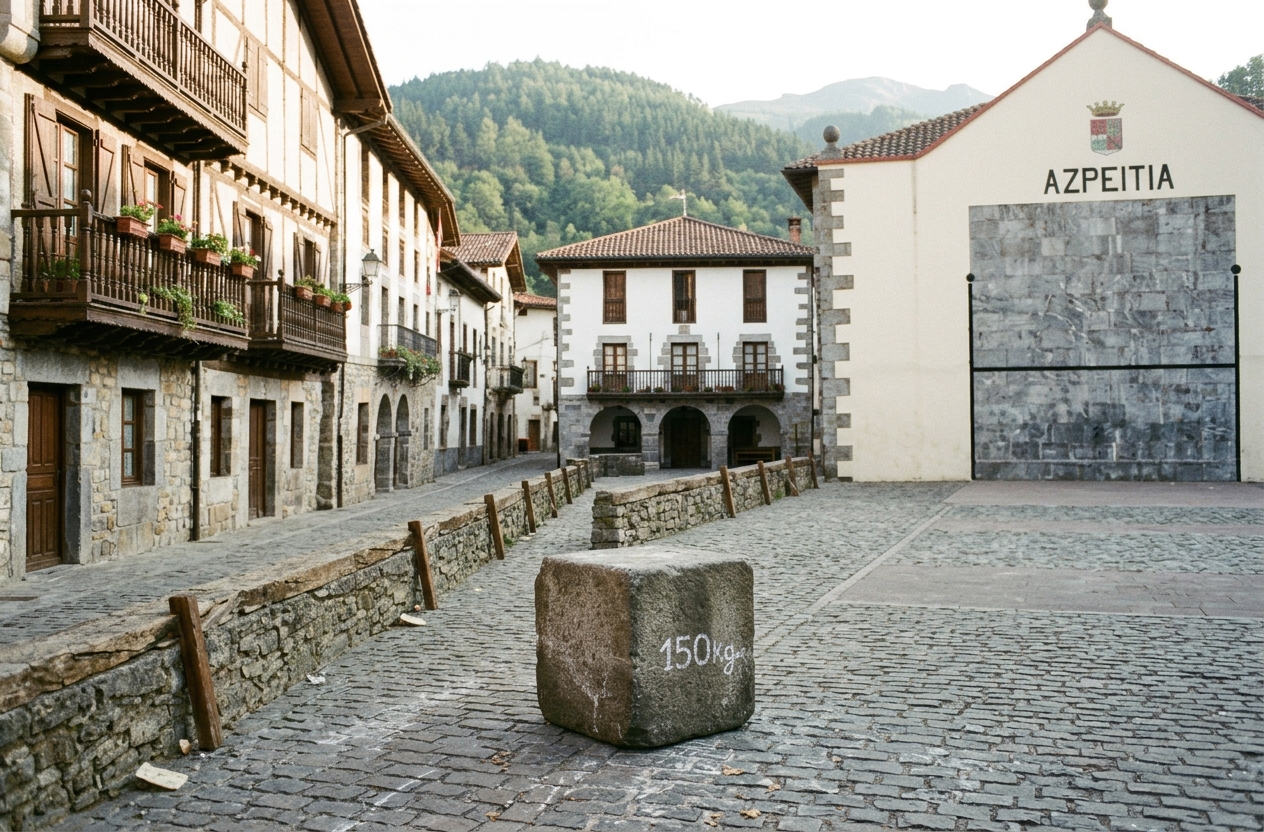
From rural work and village wagers to one of the world’s most remarkable strength sports
There are few strength sports as raw and uncompromising as Basque stone lifting. No steel bar, no perfectly balanced plates, no convenient handles. Just a heavy stone, the lifter and the challenge of getting an awkward, unforgiving object off the ground and onto the shoulder.
Known in the Basque language, Euskara, as harri-jasotzea, stone lifting is one of the most distinctive traditions of the Basque Country, a region spanning parts of northern Spain and southwestern France. It belongs to a wider family of rural sports known as herri kirolak, which grew out of the physical demands of traditional working life.
Although its exact origins remain uncertain, Basque stone lifting has developed into a highly technical competitive discipline, with established stone shapes, formal championships and athletes capable of moving extraordinary weights. Its history is also a reminder that strength sports did not begin in modern gyms. Long before barbells and weight machines, people were already testing their strength against the simplest and most unforgiving resistance imaginable: stone.
From Everyday Labour to Tests of Strength
The precise beginnings of Basque stone lifting are difficult to establish because written records of its early history are scarce. However, its roots are commonly associated with the agricultural, quarrying and construction work that shaped life in the Basque countryside.
In communities where stone was used to build houses, walls, roads and other structures, people regularly encountered heavy rocks and blocks that had to be moved by physical effort. Quarry workers, farmers and labourers developed the strength and practical skills required to handle demanding loads. It is easy to imagine how an ordinary task could become a test of ability: one person lifts a stone, another attempts to lift a heavier one, and soon a crowd gathers to watch.
This pattern was not unique to the Basque Country. Many traditional strength sports developed from the work people did every day. Logging, farming, quarrying and construction all demanded physical qualities that could later be demonstrated in contests.
In the Basque Country, such contests became part of village life and public festivities. Strength challenges offered entertainment, local prestige and an opportunity for individuals to demonstrate their physical capabilities in front of their neighbours.
Nevertheless, it is important to distinguish plausible origins from documented history. Although stone handling may be ancient, the surviving evidence does not establish exactly when Basque stone lifting first began or how its earliest practitioners performed it.
The First Documented Challenges
One significant date in the history of the sport is 15 March 1885. Historical research identifies a stone-lifting challenge held in Ermua, in Biscay, between two men from neighbouring communities. Their names have not been established in the surviving account, but the contest reportedly attracted a large crowd, including spectators who placed bets on the outcome.
This event offers a glimpse of stone lifting as it emerged into documented public competition during the nineteenth century. The challenge was not simply about moving a heavy object for practical reasons. It had become a spectacle in which strength could be compared, reputations could be won and spectators could become emotionally invested in the result.
Such contests often relied on direct rivalry. One participant attempted a lift, and the other responded. Depending on the challenge, the competitors might seek to lift a heavier stone or outperform their opponent through repeated efforts.
The stones used in these early contests were not necessarily uniform. Natural rocks varied in size, shape and weight, making some much more difficult to handle than others. This unpredictability was part of the challenge, but it also made it difficult to compare performances consistently.
That problem would help shape the next important stage in the sport’s development.
Arteondo and the Birth of Modern Basque Stone Lifting
A central figure in the development of modern harri-jasotzea was Víctor Zabala, better known by his nickname, Arteondo. Born in 1886, he became a prominent stone lifter in the early twentieth century and is widely credited with helping standardise the stones used in competition.
Before this transformation, lifters commonly worked with irregular stones. Arteondo helped popularise the use of stones with established shapes and dimensions, bringing greater consistency to public demonstrations and competitive challenges.
Four classic forms became associated with the sport:
- Cylindrical stones, which require the lifter to control a rounded, upright load.
- Cubic stones, with broad faces and difficult edges to grip.
- Spherical stones, which are particularly challenging because of their rounded shape.
- Rectangular or elongated stones, which demand careful positioning and control.
These shapes are not merely different appearances of the same weight. Each creates a distinct lifting problem. A rounded stone can roll or slip, while a cube presents corners that may be difficult to secure against the body. A rectangular stone distributes its mass differently and requires the lifter to find an effective position before attempting to raise it.
Standardisation also made competitions easier for spectators to understand. When athletes lifted stones of known shapes and weights, audiences could compare performances more meaningfully. The sport became less dependent on the peculiarities of whatever rock happened to be available and more recognisable as a distinct athletic discipline.
Arteondo’s rivalry with another leading lifter, Pedro María Churruca, known as Aritza, helped popularise these developments. Their contests became an important part of the story of modern Basque stone lifting.
Technique, Not Just Brute Strength
At first glance, stone lifting might appear to be a straightforward contest of muscular power. In reality, technique is fundamental.
A traditional lift generally begins with the stone on the ground. The lifter must establish a secure grip, bring the stone close to the body, raise it through a difficult series of positions and finally balance it at shoulder height. Depending on the stone and the rules, the lift may involve several adjustments as the athlete works the load upwards.
Unlike a barbell, a stone offers no standard grip. Its surface may be smooth, rough, rounded or angular. Its centre of mass may be difficult to control, and the athlete must continually adapt their position as the stone moves.
The lifter’s legs, hips, back, arms and torso all contribute, but raw strength alone does not guarantee success. Timing, leverage, grip, body positioning and the ability to maintain control are essential. An athlete who approaches the stone inefficiently may expend enormous energy without completing the lift.
Traditional competitions have often required athletes to wear protective clothing, including padded garments, to reduce the impact and friction of moving the stone against the body. The lift is commonly completed by bringing the stone to shoulder height, after which it is lowered or dropped onto a prepared landing area.
The combination of awkward loading, technical precision and repeated effort makes harri-jasotzea quite different from conventional weightlifting. It is not simply a question of how much force an athlete can produce. It is also a question of how effectively that force can be applied to an object that refuses to behave like a perfectly designed piece of gym equipment.
From Wagers to Championships
For many years, public challenges and wagers were central to the sport. Two lifters might face one another in a village square, taking turns to demonstrate their ability while spectators followed the contest.
Over time, the sport became more organised. Research into its history identifies the emergence of formal championships during the 1950s, with the first documented Basque championship taking place on 9 July 1957.
Organised competitions created opportunities to compare athletes under more consistent conditions. Different events could focus on the number of successful lifts, the weight of the stone or particular categories of stones.
The tradition nevertheless retained its connection to public celebration. Stone lifting demonstrations continue to feature at local festivities across the Basque Country, where audiences can watch highly skilled athletes perform feats that remain astonishing even to experienced strength enthusiasts.
The sport’s development did not mean that natural stones disappeared. Certain irregular stones have their own histories and reputations, and contests involving them preserve a direct link to the earlier tradition of testing strength against whatever nature provides.
The Rise of Modern Legends
As the sport developed, successive generations of lifters pushed its boundaries. Among the best-known modern figures is Iñaki Perurena, a Basque stone lifter from Leitza, in Navarre, who became internationally recognised for his extraordinary achievements.
Perurena helped bring the sport to a wider audience through record-breaking performances and public demonstrations. He is especially associated with lifting stones weighing more than 300 kilograms, a level of achievement that illustrates the remarkable combination of strength and technique demanded by the discipline.
Other celebrated lifters have continued to build the sport’s history, contributing to changes in training, lifting technique and the design of competition stones. Women also participate in modern Basque stone lifting, and dedicated women’s championships form part of the contemporary competitive scene.
The sport remains rooted in its cultural setting, but its appeal extends beyond it. For strength athletes elsewhere in the world, Basque stone lifting demonstrates how much physical ability can be developed when the object being lifted is heavy, awkward and technically demanding.
Why Basque Stone Lifting Still Matters
The history of harri-jasotzea is more than a story about lifting increasingly heavy rocks. It shows how practical physical work can develop into a cultural tradition, how informal challenges can become organised competition, and how technique can transform an apparently simple task into a specialised athletic discipline.
For anyone interested in sandbag training, strongman events or unconventional lifting, Basque stone lifting offers a particularly compelling example. A stone has no handles, no convenient balance and no standardised grip. It forces the lifter to adapt to the object rather than expecting the object to accommodate the lifter.
That is part of its enduring appeal. The challenge is immediate and unmistakable: there is a heavy stone on the ground, and the athlete must find a way to lift it.
Today, Basque stone lifting preserves a connection to the physical traditions of rural life while continuing to evolve as a competitive sport. Its athletes carry forward a legacy built on patience, courage, technical skill and extraordinary strength.
From village challenges in the nineteenth century to modern championships and record attempts, the principle remains remarkably simple.
The stone does not care about your reputation. It only responds to what you can actually lift.
Leave a Reply